How to Set Up a WordPress Staging Site and Push Changes Live Safely
A staging site lets you test updates on a copy before customers see them. Learn how to create one, lock it down…
A white label developer builds WordPress work that you deliver under your own brand. See how it works, what to agree first and when it is not a good fit.
White label WordPress development means that a developer or team builds WordPress work for you, and you deliver it to your client under your own brand. Your client deals with you, and the partner works behind the scenes, as far as you agree beforehand. Agencies, freelancers and studios use it to take on more projects without hiring a developer for each one. This guide explains how it works, how a typical project runs, what to agree first, and when it is not the right choice.
In a white label arrangement you stay the front: you own the client relationship, the pricing and the brand. The partner does the WordPress work (websites, Elementor builds, WooCommerce stores, plugins, fixes) to your brief and hands it over for you to deliver. It suits agencies and freelancers who sell more WordPress work than they can build themselves. It needs a clear brief, written scope and agreed rules about branding, communication and confidentiality before work starts.
How this guide was prepared: it describes how white label WordPress work is normally organised and how we run it at wpallsolution. It is general information, not legal advice; ask a qualified adviser about contracts. We make no claims about savings or results.
“White label” comes from products sold under another company’s label. In services, the partner’s name does not appear on the client’s project. The deliverable can be a full website, a set of pages, a WooCommerce store, a custom plugin or a block of maintenance and bug fixing. The partner does not need to talk to your client at all, unless you decide that a call would help.
It helps most when demand is uneven: you can say yes to a project without hiring first.
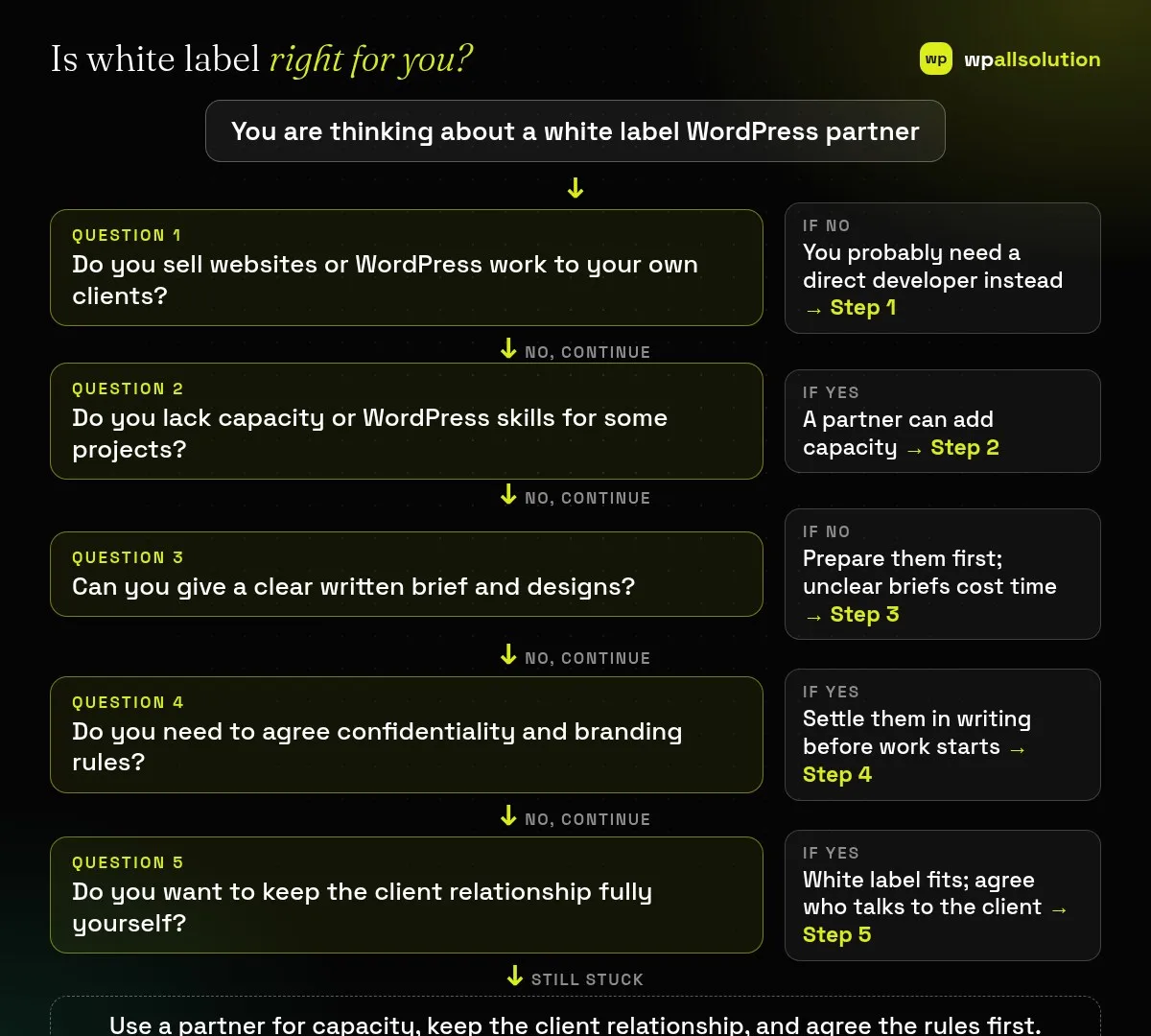
White label works when you already sell websites or WordPress work. You set the price for your client; the partner agrees a separate price with you. If you do not yet have clients for this work, a direct developer may suit you better.
List the work you want to hand over: builds, fixes, WooCommerce setups, Elementor pages, maintenance. Be honest about what you cannot do or do not have time for, and keep what you do best, usually design, strategy and the client relationship.
You send the goal, designs or references, content and images, required plugins or integrations, the deadline and the contact person. The clearer the brief, the fewer revisions. Do not send passwords or client data in the brief; access is arranged securely. See our white label WordPress development service for how we handle briefs.
Before work starts, agree branding (whether the partner may be named), communication (whether the partner may contact your client), confidentiality (including any NDA), pricing and milestones, the number of revision rounds and any support period after handover. Different agencies agree different rules, and a clear agreement protects both sides.
The partner builds to the agreed scope, you review, and the agreed revisions are made. Handover includes the finished work in a form you can deliver to your client, with the access and documentation you agreed. Maintenance after launch can be part of the same arrangement; see WordPress maintenance packages.
Only if you tell them. The branding rules are agreed before each project.
By default no. You decide whether a call would help and how it works.
You can raise an NDA or confidentiality agreement before you share anything sensitive. We agree the terms for the project; this article is not legal advice.
Builds, Elementor and Gutenberg work, WooCommerce stores, plugin and theme work, bug fixing and maintenance, subject to scope.
Related guide: How to Brief a White Label WordPress Developer (with a Brief Checklist)
Write down the work you want to hand over and your rules for branding and communication, then ask a partner how they would run it. wpallsolution works with agencies and freelancers under their own brand; see our white label WordPress development service or contact us with your brief. We tell you honestly whether a project is something we can take on, and we cannot promise results without seeing your brief.
A staging site lets you test updates on a copy before customers see them. Learn how to create one, lock it down…
Most break-ins start at the login screen. Use this practical checklist for passwords, two-step login, admin accounts, attempt limits and HTTPS.
Care plans give agencies steady work after launch. See how white label WordPress maintenance works, what to include and what to agree…
Black FridayCyber Monday sale
Before you go,
Our biggest discount of the year on the first payment of every maintenance plan.
BF2026 at checkout